← Back
From offshore wind to environmental monitoring: engineering custom ocean observation systems
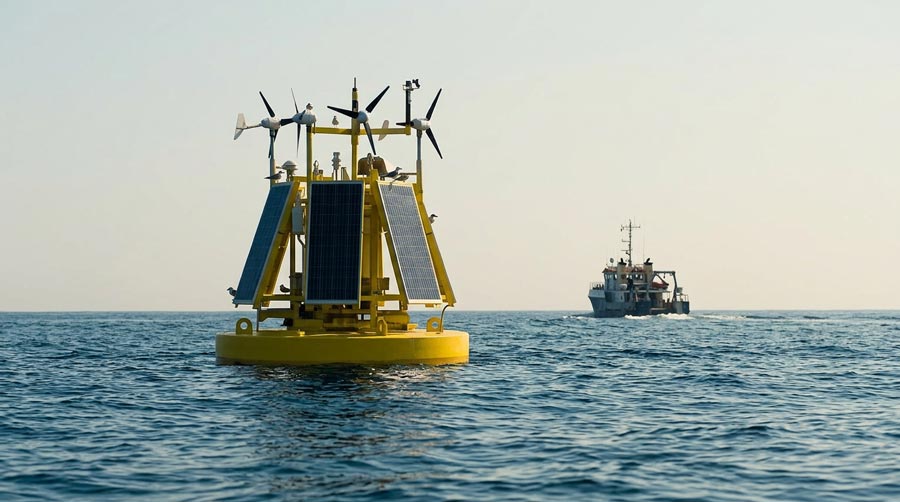
Designing reliable marine monitoring systems beyond standard instrumentation
Whether supporting offshore wind developments, dredging campaigns or coastal infrastructure projects, marine monitoring systems must operate continuously in challenging marine environments while delivering reliable environmental data.
Meeting these requirements goes far beyond assembling sensors on a floating platform. Every project requires a careful balance between mechanical design, power management, sensor integration, communications architecture and long-term operational reliability.
This engineering capability has become one of the strengths of CLS South Africa, where multidisciplinary teams design, manufacture and validate bespoke ocean observation systems adapted to the operational needs of each project.
From floating LiDAR to environmental monitoring

The same engineering expertise that has enabled CLS South Africa to manufacture DeepCLiDAR, the Group’s floating LiDAR solution for offshore wind resource assessment, is now supporting a new generation of environmental monitoring systems.
Although the applications differ, the same engineering principles remain at the core of every platform.
Every platform is developed around the same objectives: delivering high-quality environmental measurements, ensuring autonomous operation over long deployment periods and maintaining reliable communications with operators, even in remote marine environments.
This common engineering approach allows the teams to adapt proven technologies to entirely different operational contexts without compromising reliability or measurement quality.
Supporting dredging operations with continuous water quality monitoring
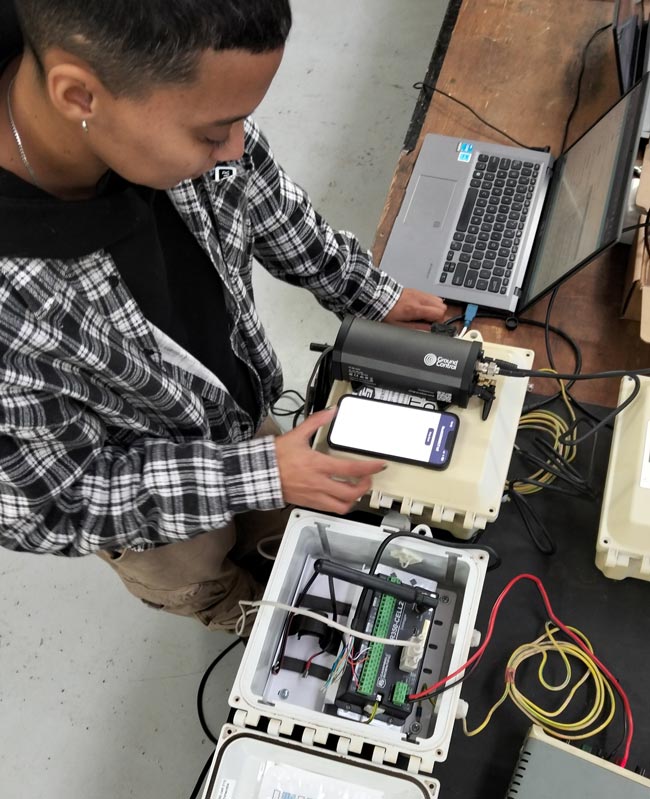
One of the latest developments illustrates this engineering expertise.
To support dredging activities associated with port expansion and marine infrastructure projects, CLS South Africa has designed and manufactured a bespoke water quality monitoring buoy capable of continuously measuring turbidity and underwater light conditions throughout operations.
Rather than supplying individual instruments, the engineering teams developed a complete observation platform integrating oceanographic sensors, embedded electronics, power management and satellite communications into a single autonomous system designed for demanding deployment conditions.
Reliable data transmission is ensured through RockREMOTE Mini and Iridium Certus® 100, allowing environmental measurements to be transmitted continuously from areas where terrestrial communications are unavailable.
The resulting data provides operators with near real-time visibility of changing environmental conditions, helping them optimise dredging activities, demonstrate regulatory compliance and better understand sediment resuspension throughout the project lifecycle.
Engineering designed around operational performance
Unlike standard monitoring equipment, every system developed by CLS South Africa is engineered according to the operational constraints of each project.
Mechanical architecture, buoyancy, energy autonomy, sensor configuration, telemetry and onboard electronics are integrated as a complete system before undergoing validation and testing.
This systems engineering approach ensures long-term reliability while reducing operational risks once deployed offshore.
Beyond the hardware itself, it allows environmental measurements to become operational intelligence that can support day-to-day decision making throughout marine infrastructure projects.

One engineering capability, multiple environmental applications
The development of this custom monitoring buoy demonstrates how CLS engineering capabilities extend well beyond a single application.
The same multidisciplinary expertise supports offshore wind measurement campaigns through DeepCLiDAR, satellite-derived wind resource assessment with SARWind, numerical wind modelling provided by Meteodyn, underwater acoustic monitoring delivered by Quiet-Oceans, and remote satellite connectivity solutions from Ground Control.
Together, these complementary capabilities allow CLS to design integrated environmental intelligence solutions adapted to offshore energy, coastal infrastructure and marine environmental monitoring projects worldwide.
As offshore energy and marine infrastructure projects become increasingly complex and environmental requirements continue to grow, monitoring systems must deliver more than measurements, they must provide reliable, actionable environmental intelligence.
By combining mechanical engineering, electronics integration, oceanographic instrumentation and satellite connectivity, CLS South Africa continues to expand the Group’s ability to deliver bespoke ocean monitoring systems engineered for real operational challenges.